Aave’s Debt Dilemma: Understanding the Ethereum Correlation Trade
The Aave Situation
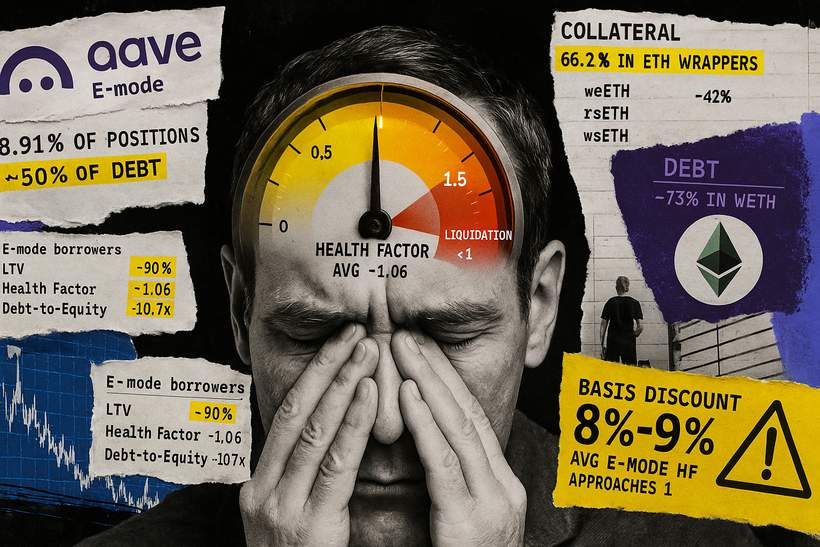
So, picture this: Aave, a big player in the DeFi world, has found itself in quite the pickle! As of August 7, according to Galaxy’s snapshot, Aave reported a whopping 19,073 loans floating around, with less than 9% of those positions using something called E-mode. And guess what? These positions are responsible for about half of Aave’s total debt! How’s that for a fun fact?
Looks Like Ethereum’s the Star here
Now, what’s really capturing everyone’s attention is the Ethereum correlation trade that’s running the show. These positions are showing a debt-weighted loan-to-value ratio of nearly 90%. Oof! That’s close to risky business!
In a nutshell, the rest of Aave’s 91% of positions have a much healthier debt-weighted LTV around 49%. Let’s call them the overachievers of the group, boasting an average health factor of about 1.79! Way to go!
Collateral Conversations
Hold onto your hats because here comes the juicy stuff: Galaxy discovered that some Ethereum staking and restaking wrappers—which you might have heard of, like weETH, rsETH, and wstETH—are making up nearly 66.2% of the collateral backing these loans. It’s like a party over there, and weETH is taking home the trophy with around 42% all by itself!
But wait! On the flip side, the group’s debts are primarily wrapped in WETH, which is about 73% of the whole debt spectrum. Crazy, right?
Let’s Talk Risk
Galaxy paints a vivid picture of this as a concentrated wager on Ethereum’s staking basis. But what does that mean in layman’s terms? If the value of weETH drops 10% while the WETH debt it’s tied to drops the same amount, the health factor hardly budges! Things are moving in sync, which could be great until it isn’t.
The real danger lurks in the exchange rate between these wrappers and actual Ethereum. If those wrappers start trading at a discount, you can bet your bottom dollar that the collateral loses strength faster than you can say “liquidation!”
Keep Your Eyes Peeled
Aave has a method for calculating the health factor, and when that number dips below 1, watch out! Starting from Galaxy’s 1.06 average for the E-mode group, we end up with a heroic cushion of roughly 5.7% before hitting trouble.
But if we start seeing some major discounts—think 8% to 9%—that could send the average E-mode health factor spiraling into risky territory.
The Decline of Crypto Lending
Looking at the bigger picture, Galaxy’s second-quarter report reveals that crypto lending is on a downward trend. Total crypto-related debt has dropped a significant 15.08% to $73.2 billion. Imagine taking the stairs back down slowly rather than leaping off a cliff like in 2022!
To add to the intrigue, while Aave’s E-mode debt was once the star of the show, it has now narrowed to about a 50/50 split with standard loans. The outstanding E-mode debt is dwindling—makes you wonder if the demand is still there.
What Does This Mean?
With the crypto landscape shifting, one can’t help but wonder: is the leverage in crypto spreading itself thin or is it just hoarding itself into a few positions hefty enough to shake things up?
If the discount between Ethereum wrappers and plain old ETH widens, everything’s at risk! Borrowers either need to top up their collateral or start paying off their debts. Otherwise, they risk being liquidated by the uninvited party crashers known as liquidators!
Staying Positive
On the sunny side of the street, if the ETH wrapper basis stays stable and E-mode debt continues to vanish like socks in a dryer, then yay! We might just see the concentration Galaxy highlighted fizzle out by itself without triggering a wave of liquidations.
In contrast, if everything goes haywire, pushing the average E-mode health factor towards the dreaded 1, then watch out for the liquidations! It’s like a game of musical chairs, but nobody wants to be the last one standing!
Wrapping Up
Ultimately, while crypto leverage appears to be shrinking, Aave’s numbers tell a different story! What’s left behind is huddled up in a few high-stakes positions, still hefty enough to carry some serious weight.
So, whether Ethereum itself keeps dancing to the rhythm or the wrappers start dragging behind will be the real story to watch! Stay tuned, folks!