The $30 Billion RWA Tokenization Explosion: What’s Happening in DeFi?
Real-World Assets Tokenization: The State of the Union
Welcome to the wild world of Real-World Assets (RWA) tokenization, a realm where physical stuff gets digitized, and the party is just warming up! As of now, the tokenization market is strutting around a hefty $30 billion on-chain, but hold onto your hats, folks, because only a measly $2.47 billion of that is actually frolicking in the DeFi space. This means the rest is hiding in the shadows, away from the lending markets and those fun pools we track on DeFi platforms.
Breaking Down the Numbers
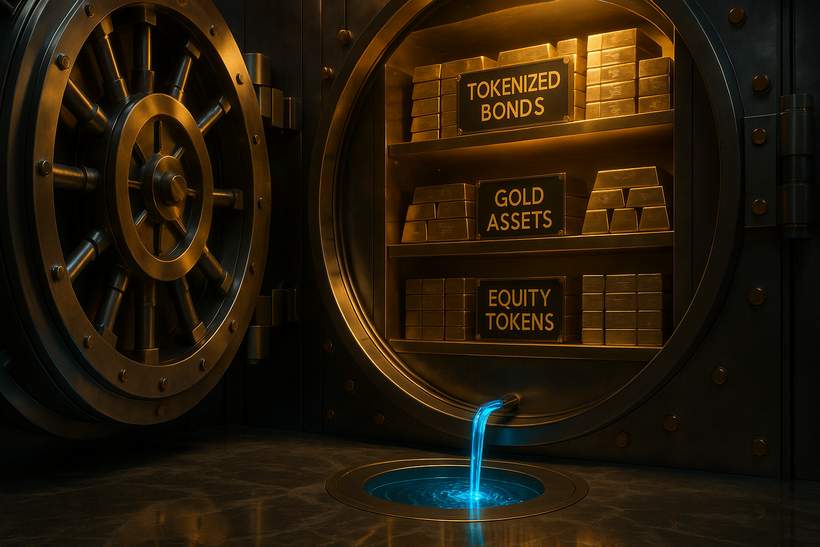
Let’s talk specifics. The big winners? Bond and money market funds have their nose in the lead, adding up to more than $16.6 billion on-chain, but only contributing a sad little $920 million in DeFi TVL (Total Value Locked). If we peek at gold and commodities, they clock in at $5.7 billion on-chain, yet they only manage to splash $183.6 million into DeFi. Stocks and equities? They’ve got $2.7 billion on-chain but just a puny $78.27 million in DeFi. Private credit, however, is playing a different game with $3.226 billion on-chain and a robust $1.257 billion in DeFi. Talk about a rags-to-riches story!
Compliance Drama
Now, some issuers are building their little kingdoms like Treasury funds and gold, but they’re keeping it all nice and regulated, which can feel a bit like being stuck in rush hour traffic. BlackRock’s money market fund, BUIDL, is playing by these rules too—only $18.9 million of its assets is dipping its toes in DeFi waters. Why? Because they’ve set up a fancy permissioned system that keeps all the action between the ‘good’ investors. BUIDL does its thing and only interacts with an elite crowd who’ve made it on the list.
The Great Liquidity Drought
Despite all the hoopla, it seems like the secondary market liquidity benefits are just not materializing. RedStone’s report highlights the complex mess of compliance, identity checks, and transfer restrictions that turn this into a high-stakes game of Monopoly—but without the fun!
Gold’s Unexpected Favor
Interestingly, tokenized gold is adding some sparkle to the party! In Q1 2026, it racked up a staggering $90.7 billion in spot volume. Yet most of that trading is happening on centralized exchanges—DeFi is still late to this particular dance, holding just a fraction of the action.
Other Players in the Game
Looking at the other players, Ondo is showing off too, crossing the $1 billion mark in TVL early in 2026 and hopping around nine blockchains like a digital kangaroo. With multiple RWA deposits surfacing on protocols like Morpho and Aave Horizon, it’s clear that some assets are ready for their DeFi debut.
Is Composability the Future?
Both DWF Labs and Centrifuge believe we’re heading down a bifurcated road: one path for ownership-first, gated transactions and another for those free-spirited assets that want to roam freely in the DeFi wilderness. It’s a battle between strict compliance structures and more flexible designs.
The Crystal Ball of Tokenization
So, what lies ahead? Well, Standard Chartered is predicting $2 trillion in tokenized assets by 2028—if we can get through the compliance jungle, that is. Otherwise, it’ll be like trying to chase a unicorn. The reality is, as long as tokenized assets are dancing to the beat of traditional finance, we might see more of these assets sticking to their cozy little corners rather than roaming open markets.
Final Thoughts
In the end, while the RWA tokenization scene is buzzing with potential, the stark divide between regulated on-chain finance and the free-for-all of DeFi suggests we’re still in the early stages. For now, folks, keep your crystals close and your wallets ready because the tokenization story is still being written—and trust me, it’s going to be one wild ride!